
A collaborative digital heritage project for the Museum of Contemporary Art of the African Diaspora. Transforming the "Game Changers" mural — a Miami landmark celebrating African Diaspora athletes — into a fully immersive 3D walkable VR environment.

A collaborative VR initiative with MOCAAD to transform physical local landmarks into immersive digital narratives. Core objective: translate the "Game Changers" Mural — a local artwork celebrating African Diaspora athletes — into a 3D interactive VR environment that educates users on the figures and social impact represented.
Bridging the gap between 2D artistic representation and 3D spatial experience while maintaining historical accuracy and cultural sensitivity. The challenge: how do you turn a "viewing" experience into a "walking" experience without losing the emotional resonance of the original artwork?
Conducted deep-dive research into the specific figures within the mural. This ensured every 3D asset and environmental detail added to the VR scene served a narrative purpose — no decorative elements without cultural meaning. Research as the foundation of spatial empathy.
For VR, "Research" is not just about facts — it is the foundation of Spatial Empathy. Understanding the history allowed the design of a space that felt "alive" and meaningful rather than decorative.
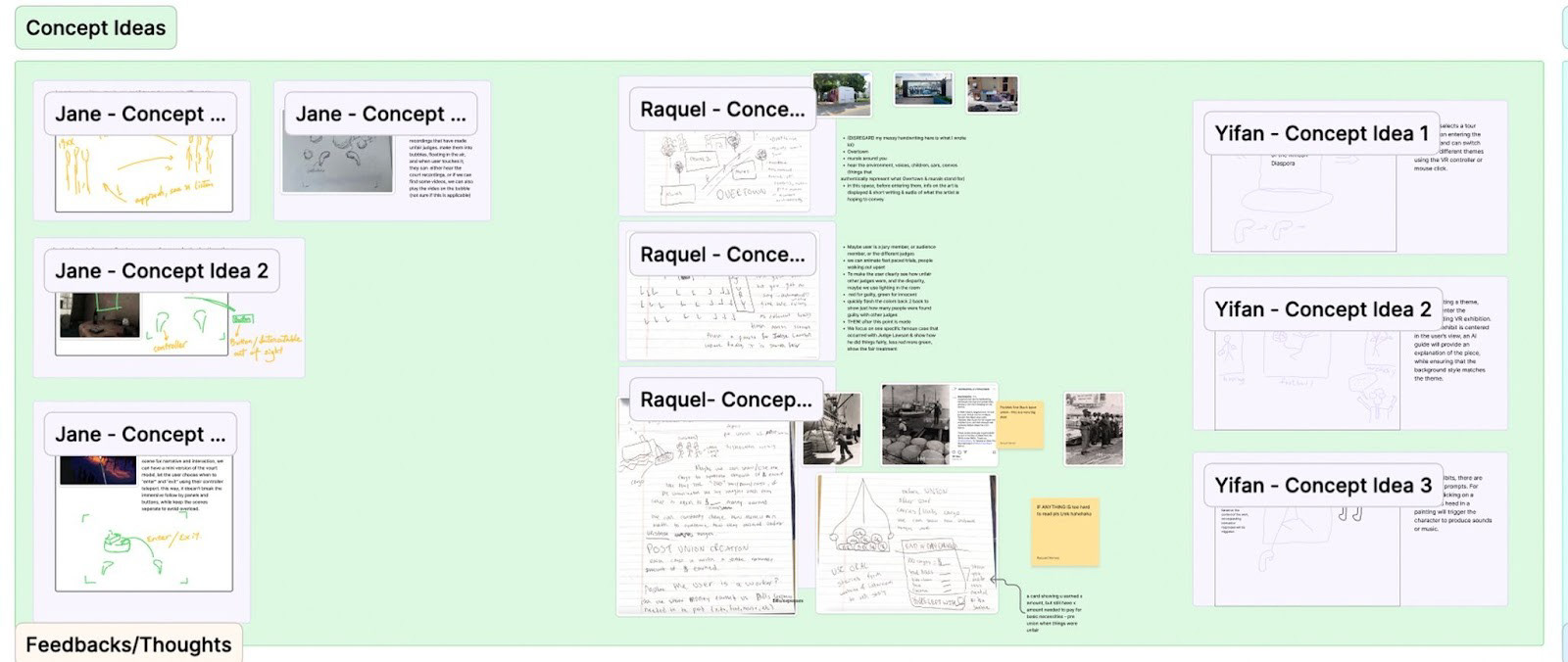
Deconstructed the mural's visual language to create a "Spatial Storyboard." Goal: transform a "viewing" experience into a "walking" experience. Each panel of the mural became a zone in the virtual space, with curated approach angles and narrative discovery moments.
Rather than text-heavy displays, the narrative was integrated directly into the environment. Soccer stars at the focal point. The space echoes the rhythm of a stadium — vibrant, athletic, alive.
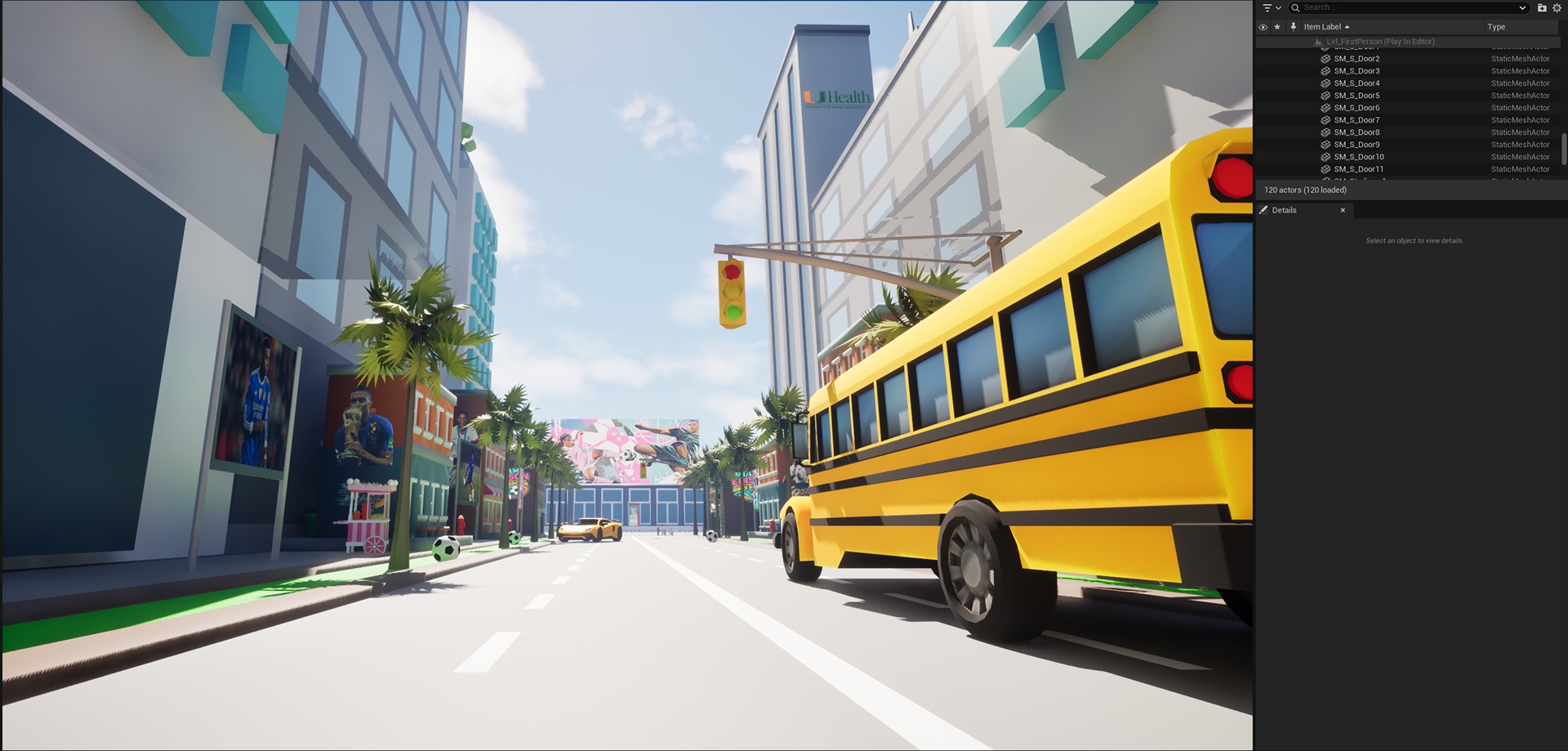
Built the virtual "Mural Space" using low-poly modeling to minimize file size and processing load — ensuring a consistently high frame rate and smooth VR performance. 120+ actors placed and optimized. Miami urban environment reconstructed with cultural artifacts as focal points.
VR performance over visual richness. Low-poly approach was a deliberate design decision — smooth presence in VR matters more than photorealism when the content itself carries the emotional weight.
Rather than using traditional text-heavy displays, the narrative was integrated directly into the environment. By placing soccer stars from the mural at the focal point of the VR space, an atmosphere was curated that celebrates the legacy of African Diaspora athletes through presence, not explanation.
The core transformation: from a 2D mural you stand in front of to a 3D world you walk through. This required deconstructing the spatial logic of the original artwork and rebuilding it as an explorable volume — preserving the emotional journey while enabling active discovery.
Every asset placement decision was filtered through historical accuracy and cultural respect. The research team's findings directly constrained what could be represented and how — making the design process inherently collaborative and the final environment genuinely educational.
Intentionally utilized low-poly modeling to ensure high frame rates and smooth VR performance. In VR, frame drops break immersion and cause discomfort — smooth presence serves the cultural mission better than photorealistic assets at lower performance.
A high-fidelity VR prototype delivered to MOCAAD — providing a scalable model for how the museum can digitize other physical murals in the future.
The project received an official nomination recognizing its contribution to digital cultural heritage and immersive spatial storytelling.
Demonstrated how local Miami cultural landmarks can be digitally preserved and expanded for global audiences through VR technology.
This project proved that for VR, "Research" is not just about facts — it is the foundation of Spatial Empathy. Understanding the history of the figures in the mural allowed the design of a space that felt "alive" and meaningful. Without the research layer, the environment would be decorative; with it, every architectural decision carries cultural weight.
Operating as the bridge between the Research team's data and the Development team's technical constraints was a vital learning experience in professional communication and project integration. Design is not just making things look good — it's translating between disciplines, ensuring the cultural mission survives every technical trade-off.